Wednesday, September 19, 2012

LET THE FALL SEASON SPEAK TO YOUR CREATIVE SPIRIT


For years, and still today, a new year begins in September and after Labor Day, as it did in my school years (before the current August start dates for school).  At least, that’s how the wheel of the year feels to me.  And I’m probably not alone in this feeling. 

Each season has its own remembered spirit and rituals, both cultural and personal, so let me share an excerpt (from the Fall section) taken (with the author’s permission) from a book which explores the essence, lessons and opportunities in each season and includes writing exercises.

From Light Year: A Seasonal Primer for Spiritual Focus by Gail Collins-Ranadive
(who holds a MFA in Poetry as well as a MA and M.Div. and is the author of several other books):


Check Light Year: A Seasonal Primer out at Amazon.com

Fall arrives, and the cool clear days speak to us of perfection with a beauty that is almost painfully poignant.

Perhaps this is because, with the diminishing of the light after the equinox, we know this time is finite.  And so, it commands our attention.

If we choose to pay attention, rather than getting caught up in the beginning busyness of the new school year, we can let this season speak to our spirits.  For there are important tasks that autumn invites us into.

In fact, the sense of urgency that comes over us as we seem to come most alive even as the earth is dying reflects the PARADOX of the season, and teaches us to live in the moment: not in the summer just past; nor into the winter to come, but in the here and now of the now here.  In this urge to be fully present, sit still and ‘know’ is an invitation to become in’form’ed by an inner creative spirit, by that which is deepest within.

One way to sit still and know is to create a special place in your home, in your life, for contemplation, for the quiet observation and reflection as the creative idea evolves.

Contemplation has been defined as ‘taking a long loving look at what’s real’ and, as with creativity, it means paying conscious attention.  But it is also a matter of opening, of expectant waiting to receive.

Considering that many of us receive messages from nature, one way to create a special space is to set out a symbol from each of nature’s elements: earth, water, fire, air…e.g. a flower or stone, some shells, a candle, a few feathers.

You may want to include a particularly meaningful image from nature that can be your companion on this journey.  It can become your symbol of transcendence, an image that points to the need for liberation from any state of being too immature, too fixed or final (in your life or in your creative writing) and it can open you to the process of change.  For autumn’s ultimate message is one of change: we can’t hold onto the perfection of its days.


Near the Fall Equinox, create a special space for the inner work of your own creative process.


Wednesday, September 5, 2012

REMEMBERING SEPTEMBER 11TH


September 11th produced strong emotions in all of us: shock, outrage, anguish, gloom and deep sorrow.  Many poets and writers wrote about their reactions to the events of that morning.  My poem, written shortly after 9/11, touches on the initial grief of those who lost loved ones in the four attacks.

SECOND WEEK OF SEPTEMBER, 2001
(IN A NEW YORK MINUTE)

Scientists say we are dust,
fine debris from the distant stars
and we are free-falling in a world
composed of soot and sediment
from the dim past, far-flung
hand-me-downs of prehistory,

not the near distance of memory:
that meal last Monday with someone
you loved and thought would remain
beside you well past middle age,
or the solid sound of the front door closing
at the start of Tuesday’s morning commute.

What does the far and unreachable past
remember?  What grace do giant stars know
before their cores collapse and burst?
Do they call out “I love you”
one last time?  Or are there no words?
The past seems so silent now.

You recognize that the clock of your heart
did not stop midmorning Tuesday
but a thick dust, coarser than any pain,
now covers your once-certain landscape.
What happened elsewhere in the universe
is so far removed that it is of no consolation.
           
— Lenny Lianne © 2001     

Let us acknowledge the heartbreak of those whose loved ones never returned home that day.


Wednesday, August 22, 2012

INTRODUCING GARY WORTH MOODY


Meet New Mexico poet Gary Worth Moody, a falconer, who lives in Santa Fe with the artist and writer Oriana Rodman, three dogs and a red-tailed hawk.  Gary’s worked as a grain elevator pit-man, forest-fire fighter, cowboy, teamster driving clydesdales, apprentice farrier, horse trainer, logger, CAT operator, form carpenter and construction project manager.  He spent a year in Siberia in 1993 building a town for coal-miners.  He is the founder of the 1980s Lost River Poetry Workshops and the past recipient of the Austin Poetry Prize, the Mary Roberts Rinehart Poetry Prize and the Virginia Downs Poetry Award.

Of Gary Worth Moody’s new book, HAZARDS OF GRACE, Stephen Bodio writes:

In a time when so much poetry is weak tea, as minimalist as haiku but without that compressed density, [Moody’s] comes on like a rare, old bourbon, rich and complex and burning like fire.  Its view of the mortality of everything is unflinching and sometimes startling, even as it celebrates life in its infinite varieties.  HAZARDS OF GRACE is the most original poetic debut I have read in years.”

Here’s a sample of Gary Worth Moody’s poetry, with its signature attention to detail and rich musicality of its language.  “Solace” is from his new book, HAZARDS OF GRACE.

SOLACE

After last night’s late autumn lightning and bars of rain
            hewn to prismed spines of feathered ice,
two dogs and I crest a red cindered rise.

Thin twined shadows of their leashes tighten, release,
            then tighten again. We descend
through frosted chamisa, cholla and buffalo

grass into an arroyo’s storm washed sand. Everywhere
            gleam shards of quartz and flint.
The earth’s iced rind holds a cuneiform of tracks, nascent scents,

signs of predawn human and animal migrations.
            Each draws the dogs’ noses,
and my eyes, to November’s first killing frost’s radiant skin.

Beyond juniper shadow, I note where a hare swerved
            from under the cold of a Red-tail’s wing.
Here a coyote’s acid breath warmed a struggling vole.

The only hint of solace, a withered condom of liquid moon,
            shielded beneath a tarp’s ragged scrim,
nests in a vacant imprint of two bodies that made love in cold rain.

Now, in wind-shorn embrace of a distant piƱon snag,
            the frantic beak of a cooper’s hawk tears
hearts, quill and breath from the ravaged husk of a mourning dove.

The hawk’s eye and the scaled eye of the dove each mock
            the frailty of our leashed trespass
into wilderness. I bend through my own breath’s fog,

unclasp each leash, watch my shadow uncurl as, under echoed
            cry of ascending hawk, the dogs run, and I,
facing unbroken sun, with upslope wind, begin the solitary walk back home.

Gary Worth Moody
From HAZARDS OF GRACE  (Red Mountain Press, 2012)

Wednesday, August 8, 2012

EKPHRASIS III: RACHEL OF ARLES

Here’s one, a combination of ekphrasis and a persona poem (in the voice of someone else) from my van Gogh book of poems.  [This my final post in a short series on ekphrasis.]


RACHEL OF ARLES

                                                I begin,
Vincent, to regard your closeness
in matched colors: stormy sky
blue eyes, the orange of your beard.

                        Some days you entered
full of sunflowers, those big ugly eyes
that watched while walls had ears
for the wild side.

                                    Your head
not yet a hill of bandages,
you saw how Rachels often end up empty
and whispered about a wedding of two
complementary colors.

                                                And I half-
hearing you rave late into night
about the fullness of color: how grays glow
with a bridelike blush and yellow in woodwork
wavers out and into shadows.

                                                With your scent
of turpentine, absinthe and death, you gave me
more than I bargained for.  The Christmas
you brought me the razored section
of your left ear, I turned away,
not wanting to see what wasn’t there.

-- Lenny Lianne

This poem of mine is almost thirty years old.  Though it’s gone through many revisions, the poem always has been spoken by Rachel.

Who was Rachel?  According to the brief police report printed in the Arles newspaper the day after Vincent van Gogh cut off part of his earlobe, he gave the section of ear to a certain Rachel, a prostitute. 

Vincent cut off part of his ear on Christmas Eve and gave it to Rachel as a token of himself, or perhaps as a Christmas present.

How did I come to write this poem?  When I lived in Northern Virginia, and before I started taking courses toward in MFA in Creative Writing (Poetry), I often took courses at the Washington Writers Center, now in Bethesda, Maryland.  One of those brief courses was “Nothing but Words,” taught by Rod Jellema, a fine poet and teacher.  One evening he gave a six-minute writing exercise whose instructions were:

1.     Write in the present tense.
2.     Use concrete, specific words; no abstractions
3.     Try to use all of these words:
mouth
ache (as a verb)
star
pin
strip (as a verb)
hill
trouble.

After six minutes of writing, I had the first draft of the poem which, twenty-five years and quite a few revisions later, would appear in my second book, FRENZY OF COLOR, REVERIE OF LINE.


Click here to go to Amazon and see my book.


__________________________________________________________________________________

Wednesday, July 25, 2012

EKPHRASIS II: VERMEER POEMS

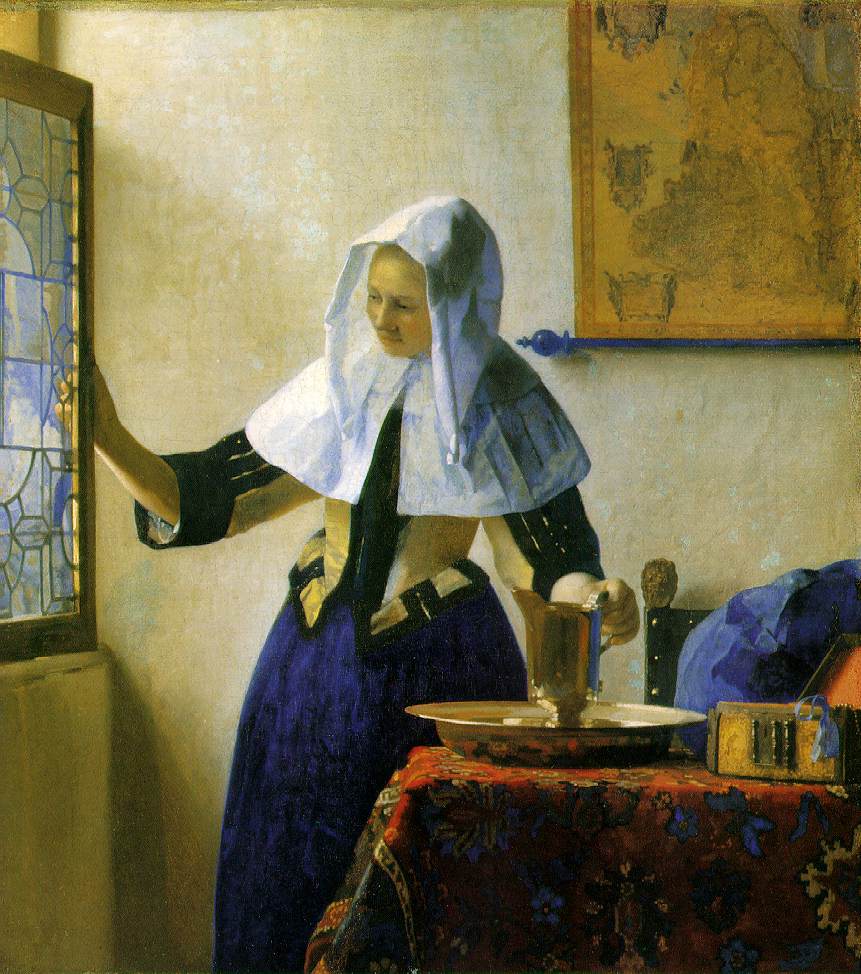
The paintings of Dutch artist Johannes Vermeer (1632 - 1675) are popular subjects for ekphrastic poems.  (For an explanation of ekphrasis and ekphrastic poems, see my previous post.)  As only 31 paintings exist which can be firmly attributed to Vermeer, and another four or five about which there is some doubt, some of Vermeer's paintings, and their people who inhabit his paintings, appear in a number of poems by different poets.


Let's look at a few Vermeer poems.


Stephen Mitchell, poet and translator, writes about Vermeer's Young Woman with a Water Jug in his poem entitled, "Vermeer."


On first reading, the poem resembles a lovely, straightforward description:


          She stands by the table, poised
          at the center of your vision,
          with her left hand
          just barely on
          the pitcher's handle....


But go back to the epigraph which is in Latin, from the Bible's New Testament.  The short line from Luke 1: 48 translates as "For he hath regarded the low estate of his handmaiden ...."  The poem now enlarges and the figure described in Mary, after the Annunciation, when she knows she is pregnant with Jesus.


          How weightless her body feels
          as she stands, absorbed, within this
          fulfillment that has brought more
          than any harbinger could.


And, finally, the poet writes that this woman gazes fondly "as though the light at the window/were a new-born child."
* * *                                              * * *                                                        * * *    
Ira Sadoff's "Vermeer: Girl Interrupted At Her Music" approaches the painting in several interestingly-different ways.


Though Vermeer’s artwork typically centers around women, Sardoff has the man giving the music lesson as the main character.  In telling the “story” of the painting, Sardoff also invents what happened moments prior to the scene depicted by Vermeer:

            When her mother entered the room, he did not
            look up.  The young girl’s pale skin turned
            white as the shawl she wore…

After what the reader may assume is a quick inspection of the room and its two occupants, the mother leaves and between the girl and her teacher

                                                                                    nothing
            so heavy as speech would be uttered between them,
            for there were still lessons to be learned,
            what was to be played would soon be played out.

The last line suggests the possibility of further, uninterrupted events between the man and the girl occurring beyond the moment of the painting.
* * *                                                     * * *                                      
On the other hand, Lawrence Raab’s “Great Art”


                                                                               Click here for Lawrence Raab's poem.


uses “Girl Asleep at a Table” by Vermeer

as merely an example to further his ideas and not as the main focus of his poem.  Raab establishes early that he dislikes paintings crowded with too many people and he’s most happy

            where you sense the artist changing his mind,
            and sometimes a shape’s been painted over,
            although the ghost of it remains.

He explains that Vermeer’s painting currently depicts a young woman who

            …leans on one hand, dreaming
            perhaps of love…

whereas x-rays show that at one time a man was in the painting.  (The subject of her dreams?)  Raab, pleased that Vermeer decided to leave out the man and “not to show that much.”  He concludes the poem with

            Let her keep her dreams to herself.
            Let the light be our secret.
There are many more than these three poems which include, or are about, Vermeer’s paintings.  They, like the poems discussed, use various methods to engage in ekphrastic writing.

Wednesday, July 11, 2012

WHAT IS EKPHRASIS?

Simply put, ekphrasis is writing about, or attempting to represent, the visual arts.  An ekphrastic poem is one written about another form of art.

Ekphrasis goes back as far as Homer’s Iliad when the poet devoted a long passage to Achilles’ shield.  This reference was used centuries later in WH Auden’s poem, “The Shield of Achilles.”


An ekphrastic poem can work in different ways.  Certainly, one approach is for the words of the poem to explain or analyze what is happening in the painting, either in the overall painting or in one or two of the details.  Another method is to use the painting/photo/print/sculpture as a stepping stone and to go your own way into a poem, that is, to transcend the original idea of the artwork and move in a different direction so your poem becomes its own entity.

There are several possible avenues to take when writing more than merely a descriptive poem about a particular artwork.

1.     Enter the painting’s setting and make its spirit and space your own.
2.     Explore the life or essence of the artist.
3.     Give your emotional response to the artwork  (Does it remind you about something in your life, past or present?)
4.     Speak the poem as someone or something in the art object (possibly have them address the artist.
5.     Speak the poem as the artist.
6.     Address the poem to the artist and ask questions.
7.     Write about what happened just before (or just after) the event in the photograph or painting.


Wednesday, June 27, 2012

CURRENT DATES OF PRIOR EVENTS AND RANDOM THOUGHTS


June 29, 1613   The Globe Theatre catches fire and burns to the ground during a performance of Shakespeare’s Henry VIII.

June 29, 1861   Elizabeth Barrett Browning dies at home in Florence at the age of 55.

June 30, 1955   James Thurber writes to the New York Post of the ravages of ages: “With sixty staring me in the face, I have developed inflammation of the sentence structure and a definite hardening of the paragraphs.”

July 2, 1961   The winner of the 1954 Nobel Prize for Literature, Ernest Hemingway, dies of a self-inflicted gunshot wound.  Describing how he worked: “When I have an idea, I turn down the flame, as if it were a little alcohol stove, as low as it will go.  Then it explodes and that is my idea.”

July 4, 1845   Henry David Thoreau begins his 26-month stay at Walden Pond: “I went to the woods because I wished to…see if I could not learn what it [life] had to teach, and not, when I came to die, discover that I had not lived.”

July 4, 1855   Walt Whitman, 36, publishes Leaves of Grass at his own expense.  The book does not sell.

Sharon Olds reminds us: “Walt Whitman didn’t sing only as a white man or a gay man.  He didn’t even sing as a living man, as opposed to a dead man.  He made the human race look like a better idea.

July 8, 1822   Percy Bysshe Shelley, 29, drowns while sailing off Viareggio and is cremated on the beach onto which his body is washed.  Strangely, his heart will not burn.  Mary Wollstonecraft Shelley carries it with her in a silken shroud for the rest of her life.

July 10, 1871   Marcel Proust is born in Auteuil, outside Paris, during the turbulent summer of the Paris Commune.  He later will blame his persistent bad health on his mother’s nervousness caused by street violence during her pregnancy.

July 10, 1873   Following an angry quarrel in Brussels, Paul Verlaine discharges a pistol at Arthur Rimbaud, wounding him slightly in the wrist.


You know, you don’t always have a choice of what you’re going to write.  You’re not like a cow that can give cream with one udder and milk with another.  Bruce Duffy

Writing is so difficult that I often feel that writers, having had their hell on earth, will escape all punishment hereafter.  Jessamyn West

I am not a writer except when I write.  Juan Carlos Onetti
***                                                     ***                                              ***